Saturday, November 05, 2011

O Sabbath rest by Galilee


Dear Lord and Father of mankind, forgive our foolish ways;
Reclothe us in our rightful mind, in purer lives Thy service find,
In deeper reverence, praise.

When I visited Israel in 2008, I discovered that the various places I visited required different levels of using my imagination to connect with how that place was "back then." In some places, there a huge gap between how it is now and how it was then; the Church of the Holy Sepulchre presented one of the biggest challenges. (I hope to blog about my experience there soon.) In other places, the gap is smaller, because those places haven't changed much in the past 2000 years. The Sea of Galilee was one of my favorite places in Israel because it had the smallest gap of any place that we visited - so small that it melts away once you are out on the water, feeling the waves lapping at the side of the boat, feeling the wind and watching the gulls play on its drafts. The captain of our boat was a Jewish man who came to Sea of Galilee to work on a boat and ended up coming to believe that Jesus was the Messiah after, as he put it, sensing the spirit of Jesus on the water.

The hymns that mention the Sea of Galilee tend to speak of it in a very romanticized and idealized way. In preparation for our trip, we are reading an excellent book by NT Wright called "The Way of the Lord", which I would highly recommend to any Christian, whether they are preparing for a trip to the Holy Land, or whether they want to imaginatively walk where Jesus walked without leaving their armchair. In his chapter on Galilee, Bishop Wright warns against a quaint idealism about Galilee, favored by the Victorians, which casts Galilee as simply a quiet, lovely place with gently sloping hillsides and a tranquil lake for fishing. Galilee is beautiful, but it is a real place. As the Gospel shows us, living in a beautiful place does not exempt people from dealing with sickness and hunger and occupation by a foreign power.

O Sabbath rest by Galilee, O calm of hills above,
Where Jesus knelt to share with Thee the silence of eternity,
Interpreted by love!

The hymn Dear Lord and Father of Mankind speaks of the Sea of Galilee as a particularly peaceful place where Jesus sought rest in his Father's presence, but it also acknowledges our all too human tendency to forget our need for Sabbath rest. I love this hymn because it speaks so eloquently of how in the busyness of our lives we so easily err and stray from God's rest like lost sheep; how we follow too much the desires and devices of our own hearts, and will be restless until we find our rest in God.

Drop Thy still dews of quietness,
Till all our strivings cease;
Take from our souls the strain and stress,
And let our ordered lives confess
The beauty of Thy peace.

Breathe through the heats of our desire
Thy coolness and Thy balm;
Let sense be dumb, let flesh retire;
Speak through the earthquake, wind, and fire,
O still, small voice of calm.

Going to Israel to see the places of the Bible, it is easy to get into "go go go" mode out of a desire to see as much as we can before we have to head back to the airport. If we are used to a high level of strain and stress and striving in our daily lives, we will have to be intentional about entering into a different mode of being on our trip, in order for this to be a true pilgrimage and not just an exercise in tourism. The Bible speaks of coming into the promised land as "entering God's rest." May we enter into God's rest on this pilgrimage.


slideshow of my pictures from the Sea of Galilee
"Dear Lord and Father of Mankind" - sung by the Scottish Festival Singers

O God of peace, you have taught us
that in returning and rest we shall be saved,
in quietness and confidence shall be our strength:
By the might of your Spirit lift us, we pray, to your presence,
where we may be still and know that you are God.

Tuesday, November 01, 2011

Jerusalem if I forget you

I never intended to turn primarily to the hymnal as my source of inspiration for this blog, but it's been a really wonderful way to focus my reflections on the church seasons. With our church trip to Israel and Palestine just around the corner, I thought it would be fun to explore music that focuses on places that we will be visiting.

I'm going to start with a song about Jerusalem that is rather unusual and doesn't show up in any hymnal: Matisyahu's Jerusalem. Matisyahu is an Hasidic Jewish reggae rapper. As far as I know, no one has tried that particular combination of religious and musical influences, but it works for him.


(my point in posting this is more the song than the video - though the video does show some recreations of the temple that give you a sense of what it would have been like.)

In the chorus of this song, Matisyahu quotes from Psalm 137:

Jerusalem if I forget you
let my right hand forget what it's supposed to do

Psalm 137 is a psalm of exile; the people of Israel are desperate to remember Jerusalem and not to forget it because they have been cut off from it. They have been forcibly removed from their land and taken to Babylon. The loss of one's homeland would be enough reason to grieve, but the people of Israel have lost more than that.

Matisyahu speaks of Jerusalem being important to his people, not simply because of the land itself, but because it is the "dwelling place of his majesty." For the people of Israel sent into exile, leaving Jerusalem and its temple meant being cut off from God's presence, because the temple is God's throne seat; the place where God concentrated his presence among them; the axis between heaven and earth. Even before they leave Jerusalem, however, the temple is not what it was; in what I find one of the most painful passages of the Bible, Ezekiel depicts God's shekinah glory slowly leaving the temple in stages. God has been showing up to the people of Israel for centuries - in the burning bush, in the pillar of cloud and fire over the tabernacle, until he comes to rest in the temple that Solomon builds for him in Jerusalem, the crown of the city, and the throne of God. But the covenant God has made with his people is broken, and as a result God withdraws his presence from the temple. The people too are removed from their land, for their presence in the land was always inextricably linked to their covenant relationship with God. The exile was the apocalyptic event for the people of Israel - the event that signaled what for them was the end of their world. Their beloved city with its temple was razed; their homeland was mostly emptied of its inhabitants; and they were again slaves to a foreign master, as in Egypt. It appeared that all hope was lost. They suspected that God had washed his hands of them.

In that context, the message of the prophets like Ezekiel and Isaiah and Jeremiah is as shocking as it is hopeful. They announced that Psalm 30:5 is a true description of Israel's God:


For his anger lasts only a moment,
but his favor lasts a lifetime;
weeping may remain for a night,
but rejoicing comes in the morning.


God would not forget them; God would restore them to relationship with him, and that would result inevitably in being restored to the land of promise, including the holy city and its temple. There are so many prophecies that focus on Jerusalem being renewed and restored, but one of my favorites is from Micah 4:

It shall come to pass in the latter days
  that the mountain of the house of the LORD
  shall be established as the highest of the mountains,
  and it shall be lifted up above the hills;
and peoples shall flow to it,
  and many nations shall come, and say:
Come, let us go up to the mountain of the LORD,
  to the house of the God of Jacob,
  that he may teach us his ways
  and that we may walk in his paths.
For out of Zion shall go forth the law,
  and the word of the LORD from Jerusalem.
He shall judge between many peoples,
  and shall decide for strong nations far away;
  and they shall beat their swords into plowshares,
  and their spears into pruning hooks;
nation shall not lift up sword against nation,
  neither shall they learn war anymore;
  but they shall sit every man under his vine and under his fig tree,
  and no one shall make them afraid,
  for the mouth of the LORD of hosts has spoken.


Jerusalem will become the place that draws not only the people of Israel but the peoples of all the nations, and they will come in order to encounter God and to learn his ways. This leads to the end of fear and war and ushers in a lasting peace, a time when Jerusalem will fulfill its destiny to be the place where God comes to live as our God, and we come to live with him as his people. Thanks be to God.

A model reconstruction of Jerusalem with its temple.

Thursday, October 13, 2011

One Church, Two Names

I looked in vain on the web for detailed pictures of the front mosaic on the Church of All Nations, also known as Church of the Agony, which I described in my last post. When I was transferring photos to my new laptop recently, I discovered to my delight that I took some really good photos that zoom in on the figures. I am returning to Israel and Palestine on November 8th to spend a couple of weeks there with a group from my church, so I've been going over my photos from my last visit.

Here is the entire pediment.


Here to Christ's right are the wise and powerful of the world - the philosophers, the rulers, the soldiers, the musicians (I *think* that's a harpist at the back), bowing in humility before Christ. One of them holds a book that says "Ignoratio," meaning ignorance. I take that as a symbol that before Christ, all of the "wisdom" of the world is revealed to be foolishness. These figures represent our need for Christ that is revealed in our misuse of our strength.

I believe all of these figures are women. The one in front holds the lifeless body of her son. Others bow their heads in grief or pain; others fold their hands in prayer and look up to Christ in hope, imploring him to intervene on their behalf. In contrast to the strength and power of those on the other side, these women represent the weakness and powerlessness of humanity - our need for Christ that is revealed in our suffering. Perhaps we are to see these two groups as connected; rulers in power are often the cause of much suffering among their people.


Jesus kneels in the center, turning his face up to the Father who sits enthroned and stretching out his hands to both of these groups, showing them to the Father and mediating on their behalf. I imagine him asking forgiveness and mercy for those to his right and for restoration and healing for those on his left.

This is also called Church of the Agony, because it is in the Garden of Gethsemane. When you read the story of Jesus' struggle there, he is focused upon his own struggle - his awareness of what lies ahead of him - suffering at the hands of the powerful - and his ultimate decision to accept that suffering because it was God's way forward for him. By connecting Gethsemane with the book of Hebrews, this mosaic suggests that in those moments of agony, Jesus interceded for all of us - for the people of all nations who have known the folly of human power and the horrors of suffering. It reminds us that he did that for us. Jesus is our Great High Priest. Thanks be to God.


Thursday, April 14, 2011

Go To Dark Gethsemane


Even after all these centuries, there is still a garden called Gethsemane on the hill across a valley from Jerusalem. It has been walled off and protected from the modern world. When I entered the garden through a door in the stone walls, I immediately sensed the peace of this place. It is beauty and tranquility are ironic, because it is famous as a place where one man underwent great spiritual agony. His torturous physical agony was still ahead of him at Pilate's seat and on the streets of Jerusalem and at Golgotha. At Gethsemane, he underwent a wrenching struggle to accept the bitter cup that was before him.

There is now a church next to Gethsemane. It is called the "Church of all Nations" and also the "Church of the Agony." It was built in the 1920s, so it's fairly recent.


It is called the Church of the Agony because when you go inside, you find a piece of bedrock where Jesus may have sweated out his struggle the night before his death. It is called the Church of all Nations for at least 2 reasons:

First and most practically, because churches from many different countries financed the building, which was telling after World War I.


Second, because of the depiction of Christ above the church doors as the mediator for humanity. Christ is clothed in red, kneeling and looking up above him to his Father, who is surrounded by angels. To Jesus' left and right are people. Those to his left are the poor and troubled - a woman weeping and carrying the body of her dead child is the most striking figure in this group. Those to his right are the powerful - a soldier, a philosopher, a rich man, all kneeling and bowing their heads. In his agony he is lifting up the sorrows of all nations - both the sorrows that come through power and those that come through weakness.

A verse from Hebrews 5:7 is in inscribed in Latin across the front of the church:

preces supplicationesque cum clamore valido et lacrymis offerens exauditus est pro sua reverentia

"Jesus offered up prayers and supplications, with loud cries and tears, to him who was able to save him from death, and he was heard because of his reverence."

I think of a different verse from Hebrews when I see this mosaic (4:15-16):

"For we do not have a high priest who is unable to sympathize with our weaknesses,

but one who in every respect has been tempted as we are, yet without sin.
Let us then with confidence draw near to the throne of grace,
that we may receive mercy and find grace to help in time of need.
"

Here's another hymn about Gethsemane (click the link for an instrumental guitar arrangement):

Go to dark Gethsemane, ye that feel the tempter’s power;
Your Redeemer’s conflict see, watch with Him one bitter hour,
Turn not from His griefs away; learn of Jesus Christ to pray.

Wednesday, April 13, 2011

Lead Me To Calvary


We are fast approaching Holy Week, the high point of the Christian year. What does it say about us as a people that our "high point" includes what by all accounts is a low point - a very, very low point, a nadir? The Christian story is not simply about triumph, success, the good stuff in life. It includes in its embrace that which is lowly, despised and painful. The things we would rather not embrace; the things we wish life didn't include; the things we might cut out of our stories if given a magic wand. If we were to write the story of Jesus, we might have him come to earth and just wave his heavenly wand and make everyone better. We might write a story in which he lives forever and doesn't undergo death. Who would ever expect their god to die?

He didn't have to undergo death. He had the divine prerogative to skip that part of human experience, but he chose to enter into our deepest source of sorrow and to transform it with his love. "Death, where is your sting?"

This morning the hymn "Lead Me to Calvary" came to my mind as I prepared my Palm Sunday sermon. Jennie Hussey, the woman who wrote the lyrics, was a Quaker who lived in New Hampshire. She was born in 1874 and died in 1958. Not much is known about her except that she spent much of her life caring for an invalid sister. She wrote poetry that was later set to music as hymns. This is a good song for Palm Sunday, because it asks God to lead us through the events of Holy Week.

This time around I am particularly struck by Jesus' struggle in the Garden of Gethsemane. The hymn asks God to

Lead me to Calvary
Lest I forget Gethsemane
Lest I forget thine agony
Lest I forget thy love for me
Lead me to Calvary

Don't let me forget what happened there. Don't let me forget that Jesus struggled as I sometimes do to accept your will. When he was on that side of the struggle, when the pain and suffering were still ahead of him, he felt the agony that humans feel when they anticipate pain - which is sometimes worse than experiencing the pain itself. I see Gethsemane as the place where Jesus inwardly, spiritually took up his cross. He was able to shoulder his literal cross in humility and submission - like a lamb before the slaughter, he did not open his mouth - because he had taken time in prayer the night before to wrestle with and finally accept the bitter cup that had his name on it. And he did it all for us.

I found a youtube video of Christians in Bangalore, India, singing this hymn in beautiful harmony:


King of my life, I crown Thee now,
Thine shall the glory be;
Lest I forget Thy thorn crowned brow,
Lead me to Calvary.

Refrain:
Lest I forget Gethsemane,
Lest I forget Thine agony;
Lest I forget Thy love for me,
Lead me to Calvary.

Show me the tomb where Thou wast laid,
Tenderly mourned and wept;
Angels in robes of light arrayed
Guarded Thee whilst Thou slept.

Let me like Mary, through the gloom,
Come with a gift to Thee;
Show to me now the empty tomb,
Lead me to Calvary.

May I be willing, Lord, to bear
Daily my cross for Thee;
Even Thy cup of grief to share,
Thou hast borne all for me.

Tuesday, January 04, 2011

on the 11th day of Christmas - In the Bleak Midwinter


by Christina Rossetti

In the bleak midwinter, frosty wind made moan,
Earth stood hard as iron, water like a stone;
Snow had fallen, snow on snow, snow on snow,
In the bleak midwinter, long ago.

Our God, Heaven cannot hold Him, nor earth sustain;
Heaven and earth shall flee away when He comes to reign.
In the bleak midwinter a stable place sufficed
The Lord God Almighty, Jesus Christ.

Enough for Him, whom cherubim, worship night and day,
Breastful of milk, and a mangerful of hay;
Enough for Him, whom angels fall before,
The ox and ass and camel which adore.

Angels and archangels may have gathered there,
Cherubim and seraphim thronged the air;
But His mother only, in her maiden bliss,
Worshipped the beloved with a kiss.

What can I give Him, poor as I am?
If I were a shepherd, I would bring a lamb;
If I were a Wise Man, I would do my part;
Yet what I can I give Him: give my heart.

on the 10th day of Christmas - Bring a Torch, Jeannette, Isabella


Bring a torch, Jeanette, Isabella

Bring a torch, come swiftly and run.

Christ is born, tell the folk of the village,

Jesus is sleeping in His cradle,

Ah, ah, beautiful is the mother,

Ah, ah, beautiful is her Son.

Hasten now, good folk of the village,

Hasten now, the Christ Child to see.

You will find Him asleep in a manger,

Quietly come and whisper softly,

Hush, hush, peacefully now He slumbers,

Hush, hush, peacefully now He sleeps.

(meant to post this last night, but here it is anyway.) Sufjan does a cover of this song, and while listening to it, I wondered who this Jeannette Isabella girl was - perhaps an obscure saint whom the songwriter imagines to be present at Jesus' birth? - so I thought I'd look into it. It is a French carol dating back to the Renaissance. Jeannette and Isabella are apparently two girls and are not of any notoriety. According to Robert Morgan (link below), the best guess is that this song references a fable in which a couple of milkmaids show up to milk the cows early in the morning after Jesus' birth and discover the Holy Family in the stable. The voice in the song urges them to run and tell the others in their village about the birth of Christ and bring a lantern so that everyone can see the baby Jesus.

At first, I don't think of this song as a theological heavyweight; its main theme is about the peaceful sleep of the baby Jesus, which is an overdone and sentimental theme. However, upon thinking about it more, I think this theme is more substantial than that. The angels tell the shepherds, "Peace on earth"; what more fitting way for that peace to be embodied than in the peaceful rest of the baby whose birth inaugurates this peace? Also this song emphasizes sharing the news with others as the right response to Christ's birth, reminding us that there is a missional dimension not just after Christ's death and resurrection but at the time of his birth as well.

George Le Tours was inspired by this song in his painting (above) of the nativity called "The Newborn" which features a young woman (is it Jeannette or Isabella?) holding a lantern up to cast a dramatic light upon Mary and Jesus. Very Caravaggio.

Robert Morgan has written a wonderful piece about this song at the Donelson Papers:

Sunday, January 02, 2011

on the 9th day of Christmas - We Three Kings


(oops, I have missed a lot of days of Christmas on this blog - mostly due to dear friends being here to stay with me!)

This morning at church we sang "We Three Kings." It was written by John Hopkins Jr, who was at the time an ordained deacon in the Episcopal church and later became a priest. He wrote this song in 1857 for a Christmas pageant at General Seminary in New York City.

Verse 1:
We three kings of Orient are
Bearing gifts we traverse afar
Field and fountain, moor and mountain
Following yonder star

Chorus:
O Star of wonder, star of night
Star with royal beauty bright
Westward leading, still proceeding
Guide us to thy Perfect Light

I have long thought that I knew this song pretty well - the first verse is well known, but I also was aware that each wise man gets his own verse to sing about the gift that he brought to Jesus. First gold as a symbol of his kingship:

Verse 2:
Born a King on Bethlehem's plain
Gold I bring to crown Him again
King forever, ceasing never
Over us all to reign
O Star of wonder...

Then frankincense as a symbol of Christ's deity, because it was an incense used for prayer:

Verse 3:
Frankincense to offer have I
Incense owns a Deity nigh
Pray'r and praising, all men raising
Worship Him, God most high

Finally, myrrh, which was used to embalm dead bodies, to foreshadow his sacrificial death:

Verse 4:
Myrrh is mine, its bitter perfume
Breathes of life of gathering gloom
Sorrowing, sighing, bleeding, dying
Sealed in the stone-cold tomb

Those four participles in the 3rd line following one after another so gruesomely and beautifully sum up Christ's passion.

Though I thought I knew this song pretty well, I have never before paid attention to the final verse until this morning:

Verse 5:
Glorious now behold Him arise
King and God and Sacrifice
Heaven sings Alleluia
Alleluia, the earth replies

It moves from Christ's death in verse 4 to his resurrection - "now behold him arise" - and then recaps his 3 identities revealed by the 3 gifts - gold for a King, incense for a God, and myrrh for a sacrifice. Heaven and earth, joined by his birth, death, and resurrection, respond in praise - "Alleluia."

This song just gets more beautiful as it unfolds. Too bad so many only have ever heard the first verse and chorus!

May Christ, who by his Incarnation
gathered into one
things earthly and heavenly,
fill you with joy and peace.

Monday, December 27, 2010

on the 3rd day of Christmas - I Will Find A Way


Here is my favorite new song for Christmas. It is really a metaphorical song about the Incarnation as a whole:

I heard Andy Gullahorn and Jill Phillips sing this live at the Ryman a couple weeks ago at the Behold the Lamb of God concert. It made me cry. I found out a little more about it on Andrew Peterson's website and blog, The Rabbit Room, when a few days later they wrote a whole post about this song and how it came to be written. It is based on a short story by Walt Wangerin Jr called "An Advent Monologue" that you can read here.

I saw a wonderful comment about this song somewhere online from a listener; they said something like this: at first I thought the song was about some woman, then I realized it was about Mary... then I thought no, it's about the world... then finally I knew it was about me.

Sunday, December 26, 2010

the 2nd day of Christmas - Once in Royal David's City


Once in Royal David's City

Once in royal David's city stood a lowly cattle shed,
where a mother laid her baby in a manger for his bed:
Mary was that mother mild, Jesus Christ her little child.

He came down to earth from heaven, who is God and Lord of all,
and his shelter was a stable, and his cradle was a stall;
with the poor, the scorned, the lowly lived on earth our Savior holy.

This song was originally a poem written by Cecil Frances Alexander, who also wrote "All Things Bright and Beautiful." She wrote "Once in Royal David's City" as a children's poem, which is why it includes some moralistic fluff, particularly in her original Verse 3, about how Jesus was such a sweet little baby and therefore all children ought to remember how good Jesus was and be just as "mild, obedient, good as he." Ahem... yeah, except for that time he ditched his parents to stay on in Jerusalem at the temple. I'm sure Victorian parents would have appreciated such behavior from their kids... Mercifully, this verse is omitted from the Episcopal Hymnal 1982 and replaced with another (see below), and a few other changes are made to the lyrics to make them a little more adult-centric (ie, "lifelong pattern" substituted for "childhood's pattern" in verse 4). This is traditionally the first song of the Lessons & Carols service held in the Advent season in Anglican churches, begun at King's College Chapel Cambridge in 1919. Watch them sing it in King's College Chapel courtesy of the BBC. Boys choir alert! So adorable and talented.

You can read the hymn in its entirety here as Alexander originally wrote it and as its appears in the Episcopal hymnal here, in which her guilt trip of a verse 3 is exchanged for a verse written by James Waring McCrady:

We like Mary rest confounded that a stable should display
heaven's word, the world's Creator cradled there on Christmas Day,
yet this child, our Lord and brother brought us love for one another

Verse 4 is perhaps my favorite. It reminds us of the theological significance of the fact that Jesus began life as a baby; as a child. God took on human nature from its very start in order to share in all of its joys and sorrows:

For he is our lifelong pattern; daily, when on earth he grew;
he was tempted, scorned, rejected, tears and smiles like us he knew.
Thus he feels for all our sadness, and he shares in all our gladness.

Verse 5 and 6 contrast the scene at Jesus' birth with the glorious day when we shall see Jesus ourselves:

And our eyes at last shall see him through his own redeeming love;
for that child who seemed so helpless is our Lord in heaven above;
and he leads his children on to the place where he is gone.

Not in that poor lowly stable with the oxen standing round,
we shall see him; but in heaven, where his saints his throne surround:
Christ, revealed to faithful eye, set at God's right hand on high.

It's really lovely how this hymn moves effortlessly from the scene at the stable to the beatific vision of Christ enthroned in heaven. I wonder if Alexander had been meditating on Philippians 2 when she wrote this, because she captures both the great humility with which Christ gave up his heavenly glory to become incarnate, to become that little baby in the manger and the restoration of that glory at his ascension. One day we will have the honor of beholding him in that glory for ourselves.

Check out Sufjan Stevens' version of this song on his series of Christmas albums, "Songs for Christmas."

Saturday, December 25, 2010

on the 1st day of Christmas

O Little Town of Bethlehem

(which the Magi would have a hard time getting to these days)

Happy Christmas! Today is only Day 1 of the 12 days of Christmas. I am determined to make a little headway towards bringing back those other 11 forlorn, forgotten days of Christmas. The 12 days of Christmas link the two great feast days, Christmas and Epiphany, which is on January 6th. As a 12 days of Christmas project this year, I thought I'd highlight a Christmas hymn each day and reflect on it a bit. Today: "O Little Town of Bethlehem."

It was written by Phillips Brooks, who was an Episcopal priest and later bishop in the 19th century. He was inspired to write this hymn after visiting the actual town of Bethlehem himself. Apparently (according to cyberhymnal.org, anyway) he assisted in a service in Bethlehem on Christmas Eve in 1865:

I re­mem­ber stand­ing in the old church in Beth­le­hem, close to the spot where Je­sus was born, when the whole church was ring­ing hour after hour with splen­did hymns of praise to God, how again and again it seemed as if I could hear voic­es I knew well, tell­ing each other of the Won­der­ful Night of the Sav­ior’s birth.

I love the line "The hopes and fears of all the years are met in thee tonight." I think it poignantly describes that essential part of human nature that is wrapped up in waiting and longing, both for the arrival of joy and for the end of suffering. This line bridges Advent and Christmas well, acknowledging the time we have just spent dwelling with our longings, waiting for things to change and telling us that we are entering a new season now that this Everlasting Light has begun to shine over the streets of this little city.

The last verse is my favorite:
O holy Child of Bethlehem, descend to us, we pray;
Cast out our sin, and enter in, be born in us today.
We hear the Christmas angels the great glad tidings tell;
O come to us, abide with us, our Lord Emmanuel!

I referenced this verse in my sermon today. It highlights that the birth of Christ is the coming of Emmanuel, the God who wants to abide with us or "dwell among us" as John 1 tells us. It reminds us that Christmas is not just about remembering one event from "back in the day"; Christ wants to come into our lives today.

Knowing that Brooks based this hymn on an actual visit to Bethlehem and not just on some cutesy romantic painting of the town makes a big difference in my estimation of this hymn. I have always liked this song (I really like the tune, in particular), but this song can be a little schmaltzy and privatized in its emphasis on role of the human heart in faith. One thing I like about Over the Rhine's adaptation of this hymn ("Little Town") is that it takes very seriously the fact that Bethlehem the actual town has struggled to find peace, particularly in the past several years. (you can find the song here).

The lamplit street of Bethlehem we walk now through the night
There is no peace in Bethlehem, there is no peace in sight
The wounds of generations, almost too deep to heal
Scar the timeworn miracle and make it seem surreal

Bethlehem is a place that is special to me, because during our trip to the Holy Lands in 2008, we stayed in a hotel in Bethlehem nearly the entire time, with the exception of one night in Jerusalem and a couple nights in Galilee. This meant that we had quite a bit of time to explore, to talk with our hotel owners who were a Christian Palestinian couple, to visit Bethlehem Bible College, to walk through the checkpoints at the wall, to understand better what is going on there. More than once I have wondered since then God might call me to live and minister in Bethlehem one day. We shall see. But perhaps we might see this little beleaguered city where Jesus chose to make his entrance into the world as a snapshot, an encapsulation of what this whole world is caught up in - both the beauty and struggle inherent in creation - a place still waiting for the final coming of its Savior to make things right again.

(the view from my hotel room in Bethlehem)

Wednesday, January 27, 2010

mother mary comes to me

The one subject that has taken up more of this blog than any other has been the question of vocation and finding a vocation that evokes from you - draws out, calls forth, speaks into being - who you are meant to be. It's time to finally tell you a story that reveals the direction in which my vocation has unfolded since the last time I wrote on this blog.

In November I was in New York, just before Thanksgiving. One evening I lined up with a bunch of other tourists outside the TKTS booth in Times Square, and I successfully scored two tickets to Jude Law's rendition of Hamlet. Getting tickets to a long-awaited play/concert stresses me out more than almost anything else - I inevitably imagine great heartbreak upon the news of the show being sold out - so I was very pleased to finally have the tickets in hand to see one of my favorite actors live and in person on stage for almost three hours and to have my old college friend on her way to join me for the play.

Some other friends of mine were back at Rockefeller Center, so I headed there to meet up with them. On my way back, I noticed a familiar blue and white sign hanging out above the sidewalk ahead of me - "The Episcopal Church welcomes you." My friends and I had already visited a few other churches in New York - St. Patrick's and St. Bart's - and they were some of the best stops we'd made. When I'm in tourist mode, exploring cathedrals and churches is one of my favorite things to do, so I ducked into the church for a few minutes to check it out before meeting up with my friends. It was called St. Mary the Virgin. I had come in behind the altar, so I walked around to the side of the chancel to see the nave and the altar. The nave was darkened, but the chancel was lit up to illuminate its crown - beautiful white marble steps leading up to a white marble altar. It was gorgeous.


As I stood and took it all in, I noticed for the first time the words engraved in the steps leading up to the altar.


MY SOUL DOTH MAGNIFY THE LORD
AND MY SPIRIT HATH REJOICED IN GOD MY SAVIOR
FOR HE HATH REGARDED THE LOWLINESS OF HIS HANDMAIDEN

The words of Mary. Beautiful. It was incredible to see that the words of a woman adorning those steps leading up to sacred space, ironically the very space in which few women have stood. Mary is our example in her humility, her bravery to step into shoes that surely felt too big, her confidence to stand there with arms aloft, singing a song of high praise to the Lord that rivals any other song in the sacred scriptures. Her hunch was right - many generations after her have called her blessed: "Blessed are you among women, and blessed is the fruit of thy womb, Jesus."

Seeing Mary's words on the steps had a lot of meaning to me, because Mary had already served as an important figure to me throughout my own discernment. Earlier I had been gently prodded towards the Visitation, Mary's meeting with Elizabeth, as a scene that I needed to meditate upon. That gentle prodding towards the story of the Visitation had the fingerprints of the Spirit all over it, as though someone had thumbed through the Bible, opened to that passage, underlined a verse, and then pushed the book in my direction:

"Blessed is she who believed
that there would be a fulfillment
of what was spoken to her by the Lord."
- Luke 1: 45

(This makes a dreadful sentence in English, but it is actually quite concise and beautiful in the Greek.)

I loved this verse in part because it was one of the few in the entire Bible that came with feminine pronouns in it; it felt like this verse spoke my "heart language," as those in Bible translation would say. This verse upheld and reinforced the two things that had been spoken to me by the Lord during a period of prayer while I was at Taize: "marriage" and "ordination." Elizabeth's words to Mary were words to me as well: I too would be blessed, if I believed that what had been promised would come to pass.

So there I was, really excited to see the Magnificat carved into the altar steps and trying to discreetly take pictures of them. I wasn't sure if pictures were allowed, but this was a moment I had to document for the future. Then the sexton came over to me and asked if I would like the lights turned on so that I could take pictures. (So much for being discreet.) Yes, that'd be great, I said. He went over to the wall and turned on a series of spotlights, which set the marble ablaze with white light. It was all even more beautiful than before. I stepped closer to the altar so that I could take a series of pictures of the steps, so that after this interlude was over and all I had were pictures, I would be able to see each of Mary's words clearly. I panned the camera left to right, framing a few words at a time and letting the sense of what Mary's words meant soak into me. Her marveling at how God has chosen her. Her "lowliness" paired with a quiet confidence, which fortified her against automatically deflecting the spotlight with an "oh, I couldn't, not me, how about somebody else." Her outspoken joy at God's goodness towards her.

This was kind of a big moment for me already. But nothing could have prepared me for what I saw next. (ha, that feels like a Dan Brown cliffhanger. get ready. if you can.)

If ever in my whole life my jaw has dropped, it was when I looked up at the side of the altar and saw my name was engraved in the marble.


Now, my last name isn't Murray, but my first and second names are "Sarah Elizabeth." As I stood there, my mind occupied with the shock of the "coincidence," my ears remembered the voice of a woman singing,

"Then will I go to the altar of God
To my joy, my delight, and my strength"

Jennifer Knapp set those words from Psalm 43 to music, and they have been ringing in my ears even since the first time I heard them. They immediately come to mind whenever I am walking down the aisle of a church towards the altar. And they came to mind while I stood there in St. Mary the Virgin near Times Square and realized that God was beckoning me to the altar, saying, Ascend these steps and stand here. Tell of what I have done for you, like Mary did. Praise me before the congregation, like Mary did. Tell the world of my marvelous works. Imitate her humility and her quiet confidence. See, I am fulfilling my promises to you even now. Blessed are you who believed that fulfillment would come.

When the Lord calls you like this, it's tough to be original in how you answer. Sometimes the only response you can muster has been used before:

"I am the handmaiden of the Lord.
Let it be to me according to your word."


deo gratias.


p.s. When I was planning my priestly ordination service, I discovered that Psalm 43 is the appointed psalm for the ordination of a priest. These sorts of divine coincidences have rippled throughout this entire process.

Tuesday, October 27, 2009

Now far ahead the road has gone, and whither then? I cannot say. - Tolkein

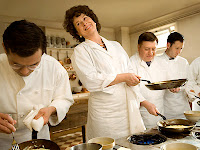
The last movie I saw in the theater was Julie & Julia. I really liked it. I enjoyed seeing a movie where women played the lead roles rather than just accoutrements or the romantic interests of a leading male character. I also enjoyed how the film delved into their attempts to discover and live out their vocation.
Take Julie. What she really wants to do is write. Instead, she works in a cubicle, answering phone calls from distraught and angry family members of those who died on 9/11. It is an exhausting and thankless job. She has another thing she really wants to do: cook. So she decides to, even if it means doing so in the little free time she has left over after work. She sets herself a daunting goal that combines both of her interests: to cook through Julia Childs' cooking book in one year and blog about it. That's 524 recipes in 365 days. To meet her goal, Julie has to carve out space and time, set goals, and deal with the challenges and friction this new "hobby" creates in the rest of her life, particularly in her marriage. She is sometimes discouraged and misunderstood, but working towards this goal is more satisfying for her than anything she did before, because she is finally simply doing what she loves. In the end, much to her surprise, this little project becomes the ticket to her dream of becoming a published writer.

Take Julia. She is living in France, the wife of a diplomat, listless, looking for something to do since she cannot fill her days with the role she longs to take up, that of a mother. Her husband, looking to steer her towards some new pastime, asks her a simple question: "What is it you really like to do?" She tells him, "Eat!" And with that, Julia begins to discover her love for cooking as more than just a hobby; she determines to learn how to cook just as well as the men studying to become professional chefs in Paris. She takes up her newfound purpose despite the significant opposition and discouragement that she encounters along the way. For much of the movie it looks as though her success will be limited; the moment when she discovers that her book will be published is so exciting precisely because it seemed that such a moment would never arrive.

Both of these women had to swim upstream as they chased after their vocations. They weren't handed their vocation in a kit; each one had to patch it together in unexpected and unconventional ways. Who would advise a young aspiring writer to start a blog about her cooking endeavors as the way to get published? Who would have ever predicted when Julia first took cooking classes in Paris that she would become a household name with her own cooking tv show? Not a soul. Not even Julie or Julia. And yet that is what happened to these real-life women. And one woman took her inspiration from the example of the other, which adds so much beauty to this movie, as it interweaves these two stories, showing how the first story ripples outwards until it sets the second off on its way. Julie puts it more dramatically: "I was drowning, and she pulled me out of the ocean."

I find much in this movie to learn about how vocation unfolds in a person's life. I see in these two women's stories how unpredictable and uncalculated that process can be. Calculation should not be abandoned, but it is so rarely the deciding factor in the best stories out there. The stories of vocation to which we find ourselves drawn are often told by folks who say, I didn't set out to end up where I did, but by grace I ended up there nonetheless. And they are grateful they ended up where they did, even though it was not their intended destination on the day they took their first step over the threshold of the familiar and out onto the way. I for one am encouraged by how, for these two women, the whole picture became something greater than the sum of the parts of their lives. I take comfort in the way that for years no one could see that whole picture, because all the parts were busy arranging and rearranging themselves until they finally fit into a beautiful mosaic. I reflect on which stories have have sent out ripples that nudged me out onto my own path, and I wonder where this path will lead - if it ends up being a good story, surely it will lead somewhere other than where I expect.

snapshot


of my evening.


tea lights lit in the window sill,
keeping watch for me and for whoever else might see them.


keep watch with those who work or watch or weep this night.

Thursday, October 22, 2009

It is what you read when you don't have to that determines what you will be when you can't help it. ~Oscar Wilde

When I was a kid, I read like crazy. I was, as adults would have said and probably did, an "avid" reader. Some of the books and characters I loved:

that endearing double set of twins, the Bobbseys.


another set of four siblings, the intrepid and resourceful Boxcar Children, who could have kept living in a train car in the woods the rest of their lives if they'd wanted to, but there were mysteries to solve!

Encyclopedia Brown. what a whiz, using math to solve mysteries.

the Babysitter Club, to which I liked to believe I belonged. remember the extra long "Super Specials" when they went on a special trip, and each chapter was narrated by a different character, with their name printed at the top of the chapter in their handwriting?


Nancy Drew.


Nancy's male counterparts, the Hardy boys.


a dream come true - the books that blurred the limits of the written page, as Nancy Drew and the two Hardy brothers stepped into the same story to solve a mystery together. To me this indicated that they really did live in the same universe, as I had always hoped they did. I wonder if Nancy ever ended up with one of the brothers or if she went back to Ned.

Apparently I had a thing for serial books; I never thought of it that way until now. And now that I think about it, I still like reading series; right now I'm working Susan Howatch's six Church of England novels. (they're better than they might sound.) but I swear that I also read books that weren't part of series when I was a kid. I also seemed to love books starring pioneer girls.

Little House on the Prairie. (ok, right, that's also a series.) These books probably shaped me and my ideals more than anything else. When Frontier House premiered on PBS, I practically drooled. I disdained that family from southern California on the show who would never appreciate the chance to live like a pioneer like I would have. they didn't do half bad, though, in the end.

Sarah Plain and Tall. not my favorite book but I had a lot in common with the main character (same first name, from Maine, so willing to try out pioneer life that she became a mail-order bride), so I felt I owed it to her to read her book. on the other hand, we weren't entirely alike. she was plain and tall. the second attribute didn't apply to me, and I hoped the first one didn't, either.

not exactly pioneer girls, but close enough. I remember checking out Little Women with great pride from the little library at Windham Christian Academy when I was maybe in 2nd grade. With great pride because I liked the way it shocked some adults, who didn't believe a girl my age could read such a long book. If I remember correctly, I returned it half-read. guess I was too young. I suspect I got bored because they were too genteel and not pioneer-y enough for my taste.

~ ~ ~ ~ ~ ~

There were hundreds of other books to which I lent my imagination, but those come to mind first. I remember hours on my checked white and blue bedspread reading in the light of the late afternoon sun (I had a north facing bedroom). I chose to spend my free time reading whenever I could. maybe I read seemingly endless book series (Babysitter Club books surpassed #130) because it meant I'd never run out of books I liked reading.

After that nostalgic look back, one might wonder what has become of this favorite pastime. The truth is my reading life is in a sad and sorry state. Other things (primarily the device on which I type this post) command my attention much more often than a book. My default time-spender is no longer a paperback but a laptop. I'm working to change that, though. I started with strategy #1 this past week: a good reading chair with a footstool to boot.


My next strategy may be a 2010 New Year's Resolution to read a book a week. Making an annual resolution has only worked for me once, but I think this is doable. I'm inspired in part by Julie of "Julie and Julia." If she can cook through Julie's book in a year, surely I can read one book a week. She had to slave over a hot stove in the kitchen; I've just got to sit here.

lego iam!

(I wanted to figure out how to say "let the reading begin," but because the subtleties of English-to-Latin translation are eluding me, for now I'll stick with this: "read now!")

Friday, September 18, 2009

sarah's list (of fun ways to trade/barter things online)


Over the past few years I have used Craig's List a lot and am one happy camper. In the past week I've sold a headset (a bluetooth earpiece), an old camera, and two stools on CL. In the past I've also used Craig's List to sell a a prom dress, a couch, and a papasan chair (which will live on in my memory, as much as it disappointed my expectations about the papasan in general). Tonight I posted a couple new ads. My philosophy is to put the ad out there at whatever price I want and keep reposting it until someone bites, since I'm not in a rush to get the cash.

The brilliance of Craig's List especially shone through when I was selling a sleeper couch that I had bought at a thrift store against my better judgment. I knew I didn't really like it, but it was cheap, and I was in a hurry to move in and set up my first solo apartment. A couple weeks later, when I found my dream couch for sale at Salvation Army, I became the owner of a two-couch living room. I posted couch #1 on Craig's List and waited... and waited... and waited. I live on the second floor of an old building, which has only a stairwell in the back of the building for moving furniture up and down floors, so it's a beast to get furniture in and out of my apartment. After a while, I despaired that anyone would answer my ad. I thought about calling Salvation Army, because at least they would take it off my hands (and out of the apartment and down the back stairs) for free. But then, finally, someone replied to my ad, and a couple of days later, I watched gleefully as someone *paid me* to remove the couch from my living room and free up the space so I could pursue my decorative dreams. And that is the beauty of Craig's List.

Freecycle is a similar idea of people in a local area trading things, but in this case no money changes hands. You offer things you want to give away for free, things for which someone could still find a use. I've used freecycle mostly for giving things away, not for getting things, b/c there's usually only one of each thing listed, and you might reply to an ad along with 10 other people, and it's up to the poster to decide to whom to give the item. Then you have to drive somewhere random in your area to pick it up. I think the only thing I've received from freecycle is a three hole punch, b/c a lady in a nearby neighborhood offered me one in response to my "wanted" request. Freecycle is wonderful; it embodies the saying "one man's trash is another man's treasure." I have posted some odd stuff on freecycle; I've posted cardboard boxes, gold scrivener's ink, and random, outdated computer equipment, and I've always found someone who was eager to come to my place and pick the items up. The only thing I've posted on freecycle that yielded zero response was a set of 4 ice trays for the freezer. I guess even frugal freecyclers already have those.

This is probably my favorite of the three. Bookmooch is not "local" like craig's list and freecycle; it extends across the country and even around the globe. Bookmooch is an online community of people who trade books. Here's how it works: You list 10 books you're willing to give away (you get 1/10 of a Bookmooch point for listing each book). Then you have 1 point with which to request a book you want from an other member's inventory. You request said book, and the other member goes to the post office and pays for it to be sent to you via media mail (or first class, if it's cheaper). Media Mail runs about $2.50 a book. Now, you don't directly reimburse the other member, b/c the other member gets your 1 point, and with it they can request a book from another member, and it's sent to them at no cost to them. This way there is no trading of $ between members; you pay whenever you send a book, and then you can get a free book sent to you. You also create a wishlist of books you want, and then you are notified when they become available. It's pretty brilliant.

If BM has a downside, it's that the inventory is limited to the books that other members have available to be "mooched;" you might not find books that interest you right off the bat. Again, this site works best if you can be patient. It's not usually good for finding the exact book you need before your class begins in the fall (although that did happen to me with Housekeeping for our ethics class in seminary!). In the three years I've been a member, I have given away 40 books I no longer wanted and have received 43 books I did want, each for about $2.50! Sounds like a deal to me. Most recently I got a copy of Interpreter of Maladies by Jhumpa Lahiri, whose short stories and novels I love. I also got Susan Howatch's entire 6-novel Church of England series through BookMooch; I need to get started on reading #3 next.